
Govindpur Birds Village
Discover Govindpur Bird Village near Debrigarh Wildlife Sanctuary. Learn how this community-led conservation program protects millions of migratory birds near Hirakud Wetland.
The Story of Govindpur Birds Village – Guardians of the Winged Guests
Tucked away in the Ambabhana Block of Odisha’s Bargarh district (around 70 kms from Debrigarh Nature Camp) lies a small settlement that has rewritten the script on grassroots conservation. Govindpur (also spelled Gobindpur), a scenic village under the Bungapali Panchayat, has earned the historic moniker of “India’s First Birds Village.” It stands as a shining testament to what can be achieved when community willpower aligns with ecological necessity. Surrounded by the dense mountain forests of the Lakhanpur Wildlife Range and Debrigarh and resting on the banks of the massive Hirakud Wetland, Govindpur has transformed itself from a quiet rural settlement into a globally recognized sanctuary of peace for millions of avian visitors.
A Strategic and Scenic Ecological Haven
Govindpur enjoys a uniquely privileged geographical location, framed by natural landmarks that make it a thriving ecosystem. To its East, lies the Ramgarh hill, while the Garjan Hill guards its Southern border. On the North-West, the village opens up to the expansive waters of the Mahanadi reservoir created by Hirakud Dam). Guarding the entry to this natural paradise is the temple of the presiding local deity, “Garjanpat,” blessing a landscape that is as spiritually grounded as it is ecologically rich.
Thanks to its position on the banks of the Mahanadi River, the local soil is remarkably fertile, sustaining lush vegetation and diverse vegetable farming. However, the true crowning glory of this region is its proximity to the Debrigarh Wildlife Sanctuary and the Hirakud Wetland. The combination of a favorable climate, a secure environment, and an abundance of food resources has long made this area a magnet for wildlife. In recognition of its global ecological importance—particularly as a crucial wintering ground for exotic birds—the area has officially been designated as a Ramsar site.
The Great Winter Migration
While Govindpur echoes with the sweet calls of resident peacocks and local birds throughout the year, the winter season brings a breathtaking transformation. As freezing temperatures grip the Northern Hemisphere, millions of migratory birds embark on arduous journeys across continents. Flying over high mountain ranges and vast plains, these winged guests arrive from some of the most remote corners of the world, including:
- Siberia
- Mongolia
- Central Asia
- Russia
- China
- The Caspian Sea region
For generations, the forests and waters adjacent to the Mahanadi reservoir have served as their refuge. Seeking a conducive atmosphere to rest, feed, and breed, these birds depend entirely on the safety and hospitality of the landscape they choose to call their winter home.
The Genesis of the “Birds Village” (2023-24)
For a long time, the arrival of these birds was merely a seasonal backdrop to village life. However, during the year 2023-24, a profound shift occurred. Under the guidance and active support of the Hirakud Wildlife Division, the residents of Govindpur decided to step up and assume full, collective responsibility for their avian guests.
In 2023, the community officially declared their home as “Birds Village – Govindpur.” This declaration was not just a symbolic title; it was a binding community pledge. The villagers promised to keep their entire ecosystem completely pollution-free, ensuring that human activity would never threaten the safety or well-being of the birds. By actively mitigating waste and preserving the cleanliness of the wetland shoreline, the community created a secure zone where birds could forage without the risk of plastic pollution or human interference.
Art as a Tool for Awareness and Education
To deepen the impact of this conservation movement, Govindpur underwent a striking visual makeover. The community realized that long-term conservation requires constant awareness, both for the younger generation of villagers and the tourists who frequent the area.
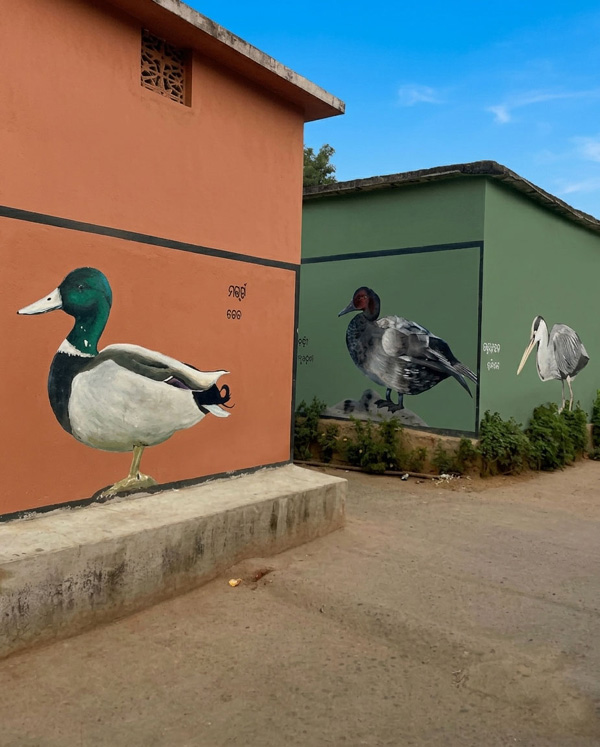
Today, almost every house wall in Govindpur Bird Village functions as a canvas. The village has been vibrant with beautifully painted pictures of the migratory birds and wild animals that inhabit the nearby Debrigarh Wildlife Sanctuary. To make these art pieces educational, the birds’ names are neatly written alongside the paintings in both the local language, Odia, and English.
This open-air gallery serves a dual purpose: it educates visitors on the specific species swimming in the nearby reservoir, and it instills a sense of shared pride and guardianship among the locals.
A Emerging Hub for Eco-Tourism
Govindpur’s unique blend of community action, rich biodiversity, and striking visual identity has quickly caught the attention of nature enthusiasts. Every year, a growing number of wildlife photographers and eco-tourists journey to the village. They come not only to witness exotic birds but also to capture rare sights unique to the region—such as the historic temples that sit beautifully submerged within the Hirakud reservoir.
The transformation of Govindpur into India’s first Birds Village highlights a crucial truth in modern conservation – Environmental protection cannot succeed through top-down government mandates alone. It requires the heart and hands of the local community. By choosing harmony over exploitation and turning their own homes into educational monuments, the people of Govindpur have set a brilliant example for the rest of the country. They have proven that when a village unites to protect nature, it does not just save a species — it preserves the very soul of its land.
Sightseeings around Debrigarh

Debrigarh Wildlife Sanctuary
Near Sambalpur, Odisha. Pin: 768030
Booking Office: 6294031617
(11am - 6pm, Mon-Sat)
Email: booking@debrigarh.com