
Leaning Temple of Huma
Visit Leaning Temple of Huma (BABA BIMALESWAR LEANING TEMPLE) near Debrigarh Nature Camp and explore an architectural mystery and feed the tame Kudo Fish.
The Leaning Temple of Huma: An Architectural & Geological Mystery
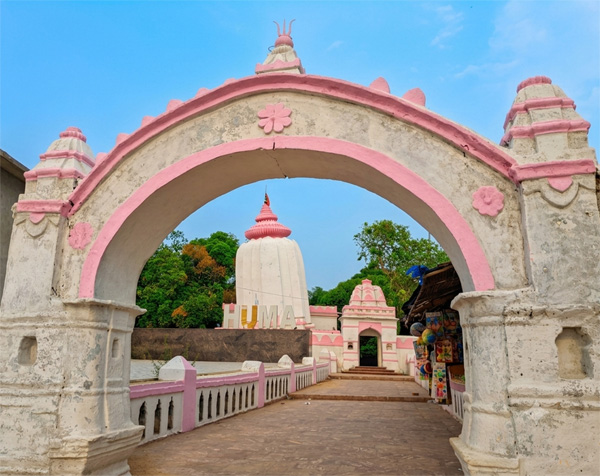
Resting on a rugged rocky outcrop along the scenic banks of the Mahanadi River sits the Baba Bimaleswar Temple, popularly known across the globe as the Leaning Temple of Huma. Dedicated to Lord Bimaleswar (a manifestation of Lord Shiva), this 17th-century marvel is located in Huma village, about 23 km south of Sambalpur and 65 km from the Debrigarh Nature Camp. This temple is one of the favourite sightseeing spots of tourists visiting Debrigarh Wildlife Sanctuary.
What makes this place of pilgrimage truly extraordinary is a phenomenon shared by only a handful of structures worldwide: virtually everything within the complex leans.
At a Glance: Visitor Information
- Location: Huma Village, on the banks of the Mahanadi River, Sambalpur District, Odisha.
- Distance: 65 kms from Debrigarh Nature Camp (An ideal addition to a heritage tour).
- Presiding Deity: Lord Bimaleshwar (Lord Shiva).
- Key Wonder: An active angle of inclination measuring 13.8 degrees; yet the pinnacle remains perpendicular.
The Mystery of the Tilt
While the world marvels at the Leaning Tower of Pisa, the Huma Temple complex offers a far more perplexing riddle for scientists, historians, and architects.
An All-Encompassing Incline
It is not just the main sanctum that tilts. The Bhairavi Devi temple (positioned to the left), the Bhairo temple (positioned to the right), the smaller surrounding shrines, and even the heavy stone boundary walls are all noticeably tilted.
The Architectural Paradox
- Opposing Directions: Intriguingly, while the main temple leans toward the West, the smaller shrines and structures tilt in entirely different directions.
- Perpendicular Pinnacle: Despite the dramatic body tilt of the structures, the pinnacle (the topmost spire) of the main temple remains perfectly perpendicular to the earth.
- Frozen in Time: Local villagers and generations of temple priests confirm that the degree of the tilt has remained absolutely unchanged for the past 40 to 50 years.
What Caused the Lean?
Experts generally rule out technical flaws or a weak foundation, given the brilliance of ancient Odishan engineering. Instead, researchers attribute the tilt to unique geological factors. The temple is built on an uneven, rocky bed right next to a massive river. It is highly probable that an internal displacement of the rocky bedrock—caused either by tectonic shifts (earthquakes) or centuries of powerful flood currents from the Mahanadi River—slightly shifted the temple’s plinth, causing the uniform yet multi-directional tilt.
The Myth of the Milkman
Local folklore attributes the temple’s spiritual origin to a humble, anonymous milkman. According to legend, the milkman used to cross the Mahanadi River daily to a spot on the bank where a natural rock cropped out from the earth.
Every day, he would pour his fresh dole of milk over the rock as an offering, only to witness the stone instantly and miraculously consume it. Word of this divine phenomenon quickly spread, catching the attention of royals and priests, eventually leading to the consecration of the land and the construction of the Baba Bimaleswar temple.
The Tame ‘Kudo Fish’ of Mahanadi
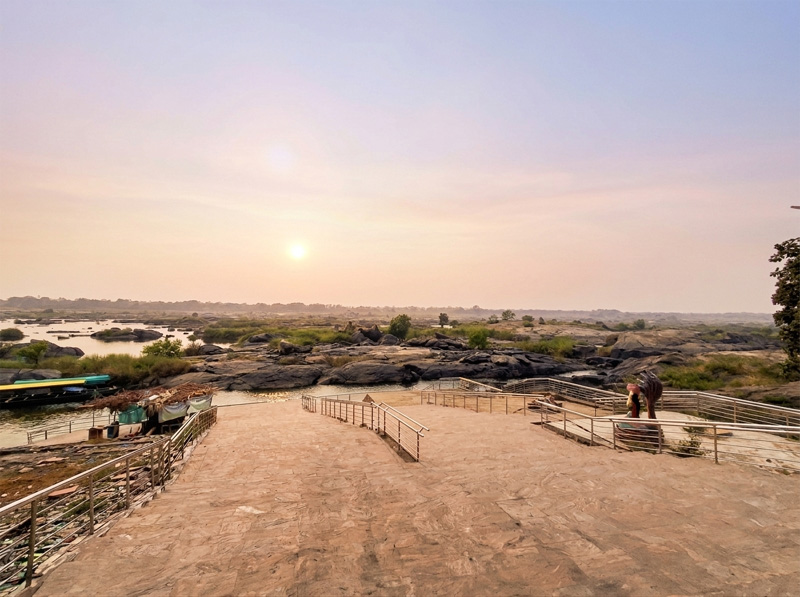
A visit to the Huma Temple (BABA BIMALESWAR LEANING TEMPLE) is incomplete without stepping down to the edge of the Mahanadi River to meet its most famous residents: the Kudo Fish.
These localized fish populate the waters immediately bordering the temple and are incredibly tame. Sheltered by the sacred status of the temple grounds where fishing is prohibited, they swim directly up to the steps (ghats). Devotees and tourists bathing or wading in the river can regularly experience the delight of feeding these fish sweets and other food directly out of their hands.
A Royal Timeline: History of Construction
The temple complex we see today is the result of centuries of royal devotion and patronages:
- Ancient Era – King Anangabhima Deva-III (Ganga Dynasty) initiates the original foundation.
- 1660-1690 AD – King Baliar Singh (5th Chauhan King of Sambalpur) rebuilds and renovates the core temple.
- 1766-1788 AD – King Ajit Singh of Sambalpur constructs the remaining smaller temples inside the complex.
Sightseeings around Debrigarh

Debrigarh Wildlife Sanctuary
Near Sambalpur, Odisha. Pin: 768030
Booking Office: 6294031617
(11am - 6pm, Mon-Sat)
Email: booking@debrigarh.com